Silica fume (also known as microsilica) is a key supplementary cementitious material used in high-performance concrete, shotcrete, UHPC, and infrastructure projects. As demand grows across India, Southeast Asia, the Middle East, and Europe, buyers are increasingly asking a practical question:
Should we choose bulk silica fume or bagged silica fume — and which option is more cost-effective?
At first glance, the difference seems simple. But in reality, true cost-effectiveness goes far beyond the price per ton. Transportation, handling, labor, storage, waste, and project scale all play a role.
This article breaks down the real cost comparison between bulk and bagged silica fume, helping contractors, concrete producers, and procurement managers make the right decision.
Understanding Bulk vs Bagged Silica Fume
Before comparing costs, let’s clarify what each option means.
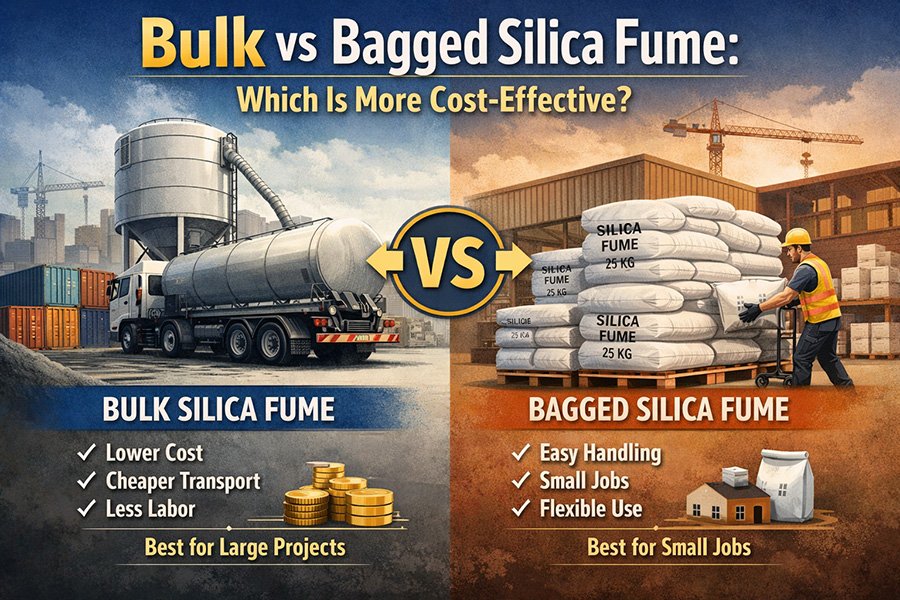
Bulk Silica Fume
- Delivered in bulk containers, tankers, or big bags (500–2000 kg)
- Often used by ready-mix plants, precast factories, and large infrastructure projects
- Designed for high-volume, continuous consumption
Bagged Silica Fume
- Typically packed in 25 kg bags or 50 lb bags
- Common in small to medium projects
- Easy to store and handle without special equipment
Importantly, both forms can be the same quality and grade (e.g. ≥85% or ≥92% SiO₂ condensed silica fume). The difference lies mainly in logistics and handling, not chemistry.
Material Cost per Ton
Bulk Silica Fume
- Lower cost per metric ton
- No small-bag packaging, labeling, or palletizing
- Reduced packaging and labor costs at the supplier side
Bagged Silica Fume
- Higher unit price due to:
- Bag materials
- Filling and sealing
- Palletizing
- Additional handling
Cost Insight:
For large-volume buyers, bulk silica fume can be 5–15% cheaper per ton compared to bagged material.
Transportation & Freight Efficiency
Transportation is often the hidden cost driver, especially in export markets.
Bulk Silica Fume
- Higher payload utilization
- Less “dead weight” from bags and pallets
- Lower freight cost per ton for:
- Long-distance inland transport
- Sea freight (containers fully loaded with product)
Bagged Silica Fume
- Bags and pallets take up space
- More loading and unloading steps
- Higher logistics cost per ton
Handling & Labor Costs On Site
Bulk Silica Fume
Advantages
- Faster unloading
- Minimal manual labor
- Suitable for automated or semi-automated batching systems
Requirements
- Bulk bag unloading frame or silo system
- Basic dust control measures
Bagged Silica Fume
Advantages
- No special equipment needed
- Flexible for small batches
Disadvantages
- Labor-intensive for large volumes
- Slower batching
- Higher risk of spillage and inconsistency
Storage, Waste & Environmental Cost
Bulk Silica Fume
- Requires dry, covered storage
- Minimal packaging waste
- Cleaner site management for long-term projects
Bagged Silica Fume
- Requires warehouse space
- Generates significant bag waste
- Disposal costs and environmental concerns
Product Consistency & Quality Control
This is often misunderstood.
- Bulk silica fume does NOT mean lower quality
- Bagged silica fume does NOT automatically mean higher quality
Both can meet:
- ASTM C1240
- EN 13263
- GB/T standards
The real factor is:
- Moisture control
- Proper storage
- Reliable supplier
Cost Comparison Summary
| Cost Factor | Bulk Silica Fume | Bagged Silica Fume |
|---|---|---|
| Material price per ton | Lower | Higher |
| Transportation | More efficient | Less efficient |
| Labor | Low (with equipment) | High for large volumes |
| Packaging waste | Minimal | Significant |
| Best project size | Medium to large | Small to medium |
When Is Bagged Silica Fume Still the Better Choice?
Despite higher costs, bagged silica fume makes sense when:
- Project volume is small
- No bulk handling equipment is available
- Storage conditions are limited
- Trial mixes or short-term jobs are required
In these cases, operational convenience outweighs material cost.
Final Verdict: Which Is More Cost-Effective?
Bulk silica fume is generally more cost-effective for medium to large-scale projects, especially when transportation, labor, and waste management are considered.
Bagged silica fume remains practical for small jobs or flexible site conditions, but costs increase significantly at higher volumes.
For concrete producers, precast plants, and infrastructure contractors, switching to bulk silica fume often results in lower total cost per cubic meter of concrete.