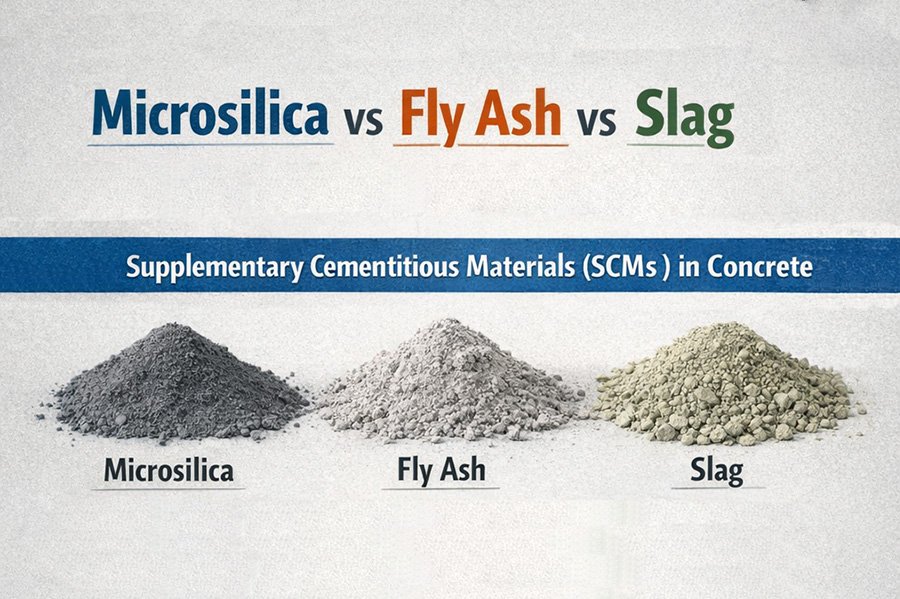
Supplementary cementitious materials (SCMs) have transformed modern concrete technology. By partially replacing Portland cement, SCMs reduce CO₂ emissions, lower material costs, and enhance long-term concrete performance. Three SCMs dominate the construction industry: microsilica (silica fume), fly ash, and ground granulated blast-furnace slag (GGBS). Each brings distinct chemical profiles, reactivity behaviors, and performance benefits. Choosing the right SCM—or the right blend—depends on your specific structural, environmental, and economic requirements.
This guide provides an authoritative, side-by-side comparison of all three materials across chemistry, workability, strength development, durability, sustainability, and cost.
What Are Supplementary Cementitious Materials?
SCMs are materials that, when combined with Portland cement and water, contribute to concrete strength and durability through hydraulic or pozzolanic activity. They react with calcium hydroxide (Ca(OH)₂) released during cement hydration—a byproduct that contributes little to strength—and convert it into additional calcium silicate hydrate (C-S-H), the primary binding compound in concrete.
The use of SCMs is governed by standards including ASTM C618 (fly ash), ASTM C989 (slag), and ASTM C1240 (microsilica), as well as EN 450, EN 15167, and EN 13263 in Europe.
Microsilica (Silica Fume): The High-Performance Powerhouse
Origin and Chemistry
Microsilica, also known as silica fume, is a byproduct of producing silicon metal and ferrosilicon alloys. During smelting, silicon dioxide vapor escapes and oxidizes, condensing into ultra-fine amorphous spherical particles with a mean diameter of approximately 0.1–0.2 µm—about 100 times finer than Portland cement.
Microsilica is composed of 85–98% amorphous SiO₂, making it an exceptionally reactive pozzolan. Its extremely high surface area (15,000–25,000 m²/kg) accelerates pozzolanic reaction.
Performance Benefits
- Compressive strength: Dramatic early and long-term strength gains. Typical replacement levels of 5–10% can push compressive strength beyond 100 MPa in high-performance concrete (HPC) and ultra-high-performance concrete (UHPC).
- Permeability reduction: Microsilica densifies the interfacial transition zone (ITZ) between aggregate and paste, dramatically reducing chloride ion penetration and water absorption.
- Chemical resistance: Excellent resistance to sulfate attack and alkali-silica reaction (ASR) mitigation.
- Abrasion resistance: Superior surface hardness makes it ideal for industrial floors, bridge decks, and marine structures.
Workability Challenges
Microsilica’s extreme fineness increases water demand significantly. Without high-range water reducers (superplasticizers), it produces stiff, difficult-to-place mixes. It also increases cohesiveness, which can be beneficial for pumped concrete but challenging for slip-form applications.
Typical Use Cases
Offshore platforms, bridge decks, parking structures, industrial flooring, precast HPC, and UHPC.
Fly Ash: The Workability Enhancer
Origin and Chemistry
Fly ash is collected from the exhaust gases of coal-burning power plants via electrostatic precipitators or bag filters. Its composition varies depending on coal source and combustion conditions. ASTM C618 defines two main classes:
- Class F fly ash (bituminous/anthracite coal): Low calcium content (<10% CaO), primarily pozzolanic, and the most widely used type globally.
- Class C fly ash (lignite/sub-bituminous coal): Higher calcium content (>20% CaO), exhibits both pozzolanic and self-cementing (latent hydraulic) properties.
Class F fly ash typically contains 55–65% SiO₂ + Al₂O₃ + Fe₂O₃, with rounded glassy particles that act as micro-ball bearings in fresh concrete.
Performance Benefits
- Workability: The spherical particle morphology reduces water demand by 5–15%, improves flowability, and extends workability time—ideal for large pours and hot climates.
- Heat of hydration: Fly ash significantly reduces temperature rise in mass concrete, minimizing thermal cracking risk. This makes it essential for dams, mat foundations, and large columns.
- Long-term strength: Although slower than Portland cement, fly ash continues to gain strength for 90+ days, ultimately matching or exceeding plain cement concrete.
- ASR mitigation: Class F fly ash is highly effective at suppressing alkali-silica reaction.
- Sulfate resistance: Enhances resistance to sulfate environments, particularly in Class F formulations.
Limitations
Fly ash slows early strength development, making it problematic where formwork stripping or load application occurs within 24–72 hours. Quality can be inconsistent due to variability in coal sources and combustion processes. Carbon content (measured as loss on ignition, LOI) can affect air-entrainment and admixture dosage.
Typical Use Cases
Mass concrete foundations, pavements, precast products, general structural concrete, and applications requiring enhanced workability.
Ground Granulated Blast-Furnace Slag (GGBS): The Durability Specialist
Origin and Chemistry
GGBS is produced by rapidly quenching molten slag—a byproduct of iron manufacturing in blast furnaces—with water or steam, then grinding to a fine powder (typically 400–600 m²/kg Blaine). This quenching process “freezes” the slag in a glassy, latent hydraulic state.
GGBS is rich in CaO (~40%), SiO₂ (~35%), and Al₂O₃ (~12%), giving it both pozzolanic and hydraulic properties. It requires alkali activation (from Portland cement hydration) to react.
Performance Benefits
- Durability: GGBS concrete exhibits outstanding resistance to chloride ingress, making it the material of choice for marine structures, tunnels, and bridge substructures.
- Sulfate resistance: The low C₃A equivalent and dense microstructure provide excellent protection against sulfate attack.
- Heat of hydration: Substantially lower heat of hydration than Portland cement (up to 50% reduction at 50% replacement), beneficial in mass concrete applications.
- Long-term strength: Continues to gain strength well beyond 28 days, often surpassing plain cement concrete at 90+ days.
- Aesthetic quality: GGBS produces lighter-colored, aesthetically refined concrete—popular in architectural applications.
- Workability: Slightly improved workability and reduced bleeding compared to plain cement.
Limitations
Like fly ash, GGBS exhibits slow early strength development, particularly in cold weather (below 10°C), where activation is significantly retarded. High replacement rates (>70%) may require extended curing and can delay formwork removal.
Typical Use Cases
Marine and coastal structures, tunnels, basement construction, water-retaining structures, mass concrete, and architectural exposed concrete.
Head-to-Head Comparison
| Property | Microsilica | Fly Ash (Class F) | GGBS |
|---|---|---|---|
| Particle Size | ~0.1 µm | 10–100 µm | 5–30 µm |
| Reactivity Type | Pozzolanic | Pozzolanic | Latent hydraulic |
| Typical Replacement | 5–10% | 15–35% | 30–70% |
| Early Strength | ↑↑ High | ↓ Low | ↓ Low–Moderate |
| Long-term Strength | ↑↑↑ Very High | ↑↑ High | ↑↑ High |
| Workability | ↓ Reduced | ↑↑ Enhanced | ↑ Slightly Improved |
| Heat of Hydration | Low reduction | ↑↑ Significant | ↑↑ Significant |
| Chloride Resistance | ↑↑↑ Excellent | ↑↑ Good | ↑↑↑ Excellent |
| Sulfate Resistance | ↑↑ Good | ↑↑↑ Excellent | ↑↑↑ Excellent |
| ASR Mitigation | ↑↑↑ Excellent | ↑↑↑ Excellent | ↑↑ Good |
| Relative Cost | $$$ High | $ Low | $$ Moderate |
| CO₂ Saving Potential | Moderate | High | Very High |
Sustainability Comparison
All three SCMs contribute to sustainability by displacing Portland cement, whose production accounts for approximately 8% of global CO₂ emissions. However, their environmental footprints differ:
- Fly ash offers the highest volume replacement potential and lowest cost, making it the most impactful SCM for reducing embodied carbon at scale. However, concerns about heavy metal leaching and coal industry dependence are growing.
- GGBS has very low embodied carbon (approximately 50–80 kg CO₂/tonne vs. ~830 kg CO₂/tonne for Portland cement) and is produced as an industrial byproduct that would otherwise require landfilling.
- Microsilica is produced in smaller volumes, commands a premium price, and is most valuable in specialized applications where its unique performance justifies the cost.
How to Choose the Right SCM
Choose microsilica when: You need maximum compressive strength, chloride resistance, or abrasion resistance. Suitable for HPC, UHPC, offshore, and industrial structures.
Choose fly ash when: Workability, heat of hydration reduction, and cost efficiency are priorities. Ideal for mass concrete, pavements, and general construction in warm climates.
Choose GGBS when: Long-term durability in aggressive environments (marine, sulfate soils) is critical. Also preferred for mass concrete and architectural concrete.
Use blended SCMs (e.g., fly ash + microsilica, or GGBS + microsilica) when you need to combine early-strength benefits with long-term durability—a common approach in modern performance-specified concrete.
Conclusion
Microsilica, fly ash, and GGBS each occupy a distinct niche in the concrete materials toolbox. Microsilica delivers unmatched strength and densification at low replacement levels. Fly ash improves workability and reduces heat at economical cost. GGBS provides exceptional long-term durability and sustainability credentials. Understanding their chemistry, reactivity, and performance profiles enables engineers and specifiers to select the optimal SCM—or combination—for each unique project demand.
As the construction industry accelerates its transition toward low-carbon concrete, strategic use of these three SCMs will be central to meeting both performance and environmental targets.